From Speculation to Balance Sheet
While crypto Twitter debates the next memecoin moonshot, a financial revolution is reshaping how public companies manage capital reserves, driven by Digital Asset Treasuries (DATs).
Digital Asset Treasuries are balance sheet allocations to bitcoin, ether, and similar digital assets by public companies. Unlike traditional cash management, DATs represent strategic treasury positions that serve as inflation hedges, diversification tools, and innovation signals to stakeholders.
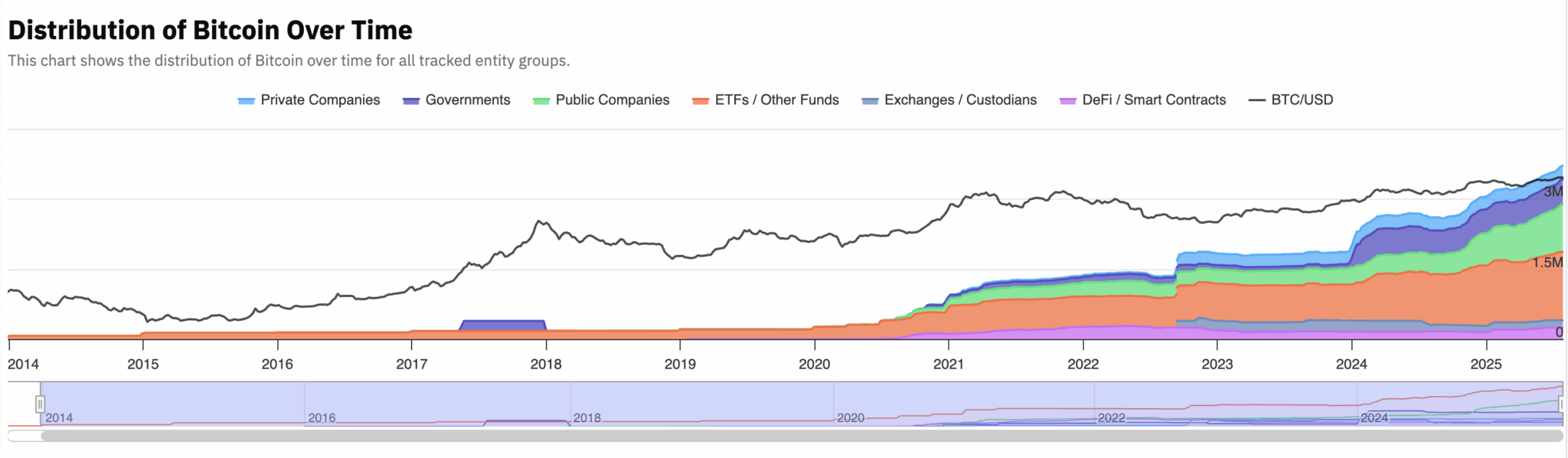
Over three-quarters of surveyed institutional allocators say they will increase digital asset exposure in 2025, with public companies potentially allocating $330 billion to bitcoin alone within five years, according to Delphi Digital. Total reported corporate digital asset holdings now exceed $78 billion globally, with nearly 70% in bitcoin.
The debate is now not whether corporates will own crypto, but which companies, why, and how much
The Six Tribes of Corporate Treasury Thinking
The DAT debate has fractured into competing narratives, but the underlying complexity defies simple categorization. Through research and stakeholder interviews, Caladan has identified six distinct schools of thought that capture how corporate leaders view DATs and their implications.
The Strategic Allocators: DATs as Core Balance Sheet Reserves
The bulls see institutional appetite everywhere. According to the 2025 EY-Parthenon/Coinbase survey, over 59% of institutional allocators expect to commit over 5% of AUM to digital assets as treasury holdings. Over 40 S&P 500 companies publicly report digital assets on their balance sheets, including MicroStrategy, Tesla, Block, and Coinbase.
MicroStrategy's shares traded at a 10-15% premium above net asset value for much of 2025, functioning as a "public bitcoin ETF proxy." The most common corporate rationales include inflation hedging, treasury diversification, and innovation signaling.
The Skeptics: DATs as Risk Bubbles and Volatility Time Bombs
Bears see dangerous volatility exposure. In the 2022-24 drawdown, companies with large BTC positions saw 60% drawdowns. S&P Global data shows companies with over 5% of cash in bitcoin reported 20% quarter-to-quarter treasury value swings, creating CFO headaches.
US GAAP and IFRS rules treat crypto as intangible assets, forcing companies to write down losses without marking up gains. Just five companies hold nearly 70% of all public company BTC balances, indicating concentrated risk.
The Prudent Innovators: DATs as Evidence of Financial Sophistication
Pragmatists see DATs as evolving treasury sophistication. Large corporates increasingly deploy risk management overlays including hedging and derivatives. In 2025, over half of new S&P 500 digital asset treasuries use market hedges or covered call overlays. Companies in Switzerland and Singapore lead adoption, showing 40% year-on-year growth in compliant reporting.
The Liquidity Engineers: DATs to Boost Treasury Efficiency
Technicians see DATs solving liquidity optimization. Corporate-held BTC and ETH generate over $15 billion daily trading volume.
A Moody's study shows S&P 500 firms holding 2-4% of treasury in digital assets experienced lower liquidity risk due to uncorrelated returns. 35% of corporates also invest in blockchain ecosystem partners.
The Power Brokers: DATs and Corporate Strategic Signaling
Strategists see DATs as signaling tools. Bernstein analysis finds new S&P 500 bitcoin treasury announcements yield 3-8% share price spikes.
For 42% of institutional asset managers, digital asset positions signal innovative treasury management. Companies like MicroStrategy and Block serve as indirect ETF alternatives.
The Market Timers: DATs as Macro Hedges and Optionality Plays
The final camp sees DATs as macro bets. Over $41 billion in net flows entered digital asset ETFs in 2025, much following corporate treasury moves. 76% of CFOs cite "inflation hedging" as primary rationale. LATAM and Southeast Asian corporates posted 25% year-on-year growth, often defending against currency erosion.
Six Scenarios, One Market
These competing philosophies aren't just academic. They're driving real capital allocation decisions that will shape corporate finance's next phase.
To understand the practical implications, Caladan has mapped each school of thought to its logical conclusion:
Winners, Losers, and Everything Between
The DAT revolution creates a complex stakeholder landscape where opportunities and risks vary dramatically by participant type:
Conclusion: The Digital Asset Treasury Revolution's Next Chapter
Digital Asset Treasuries have evolved from experimental corporate experiments to mainstream balance sheet strategy in under five years. Corporate adoption continues growing substantially, yet risks of volatility shock and earnings management complexity remain real.
The corporations emphasizing transparent risk management and rational position sizing will likely lead the next phase, while those chasing headlines through oversized allocations risk destroying stakeholder confidence. The corporate treasury revolution has begun, and success will be measured by whether it creates sustainable value or cyclical volatility.