Key Insights
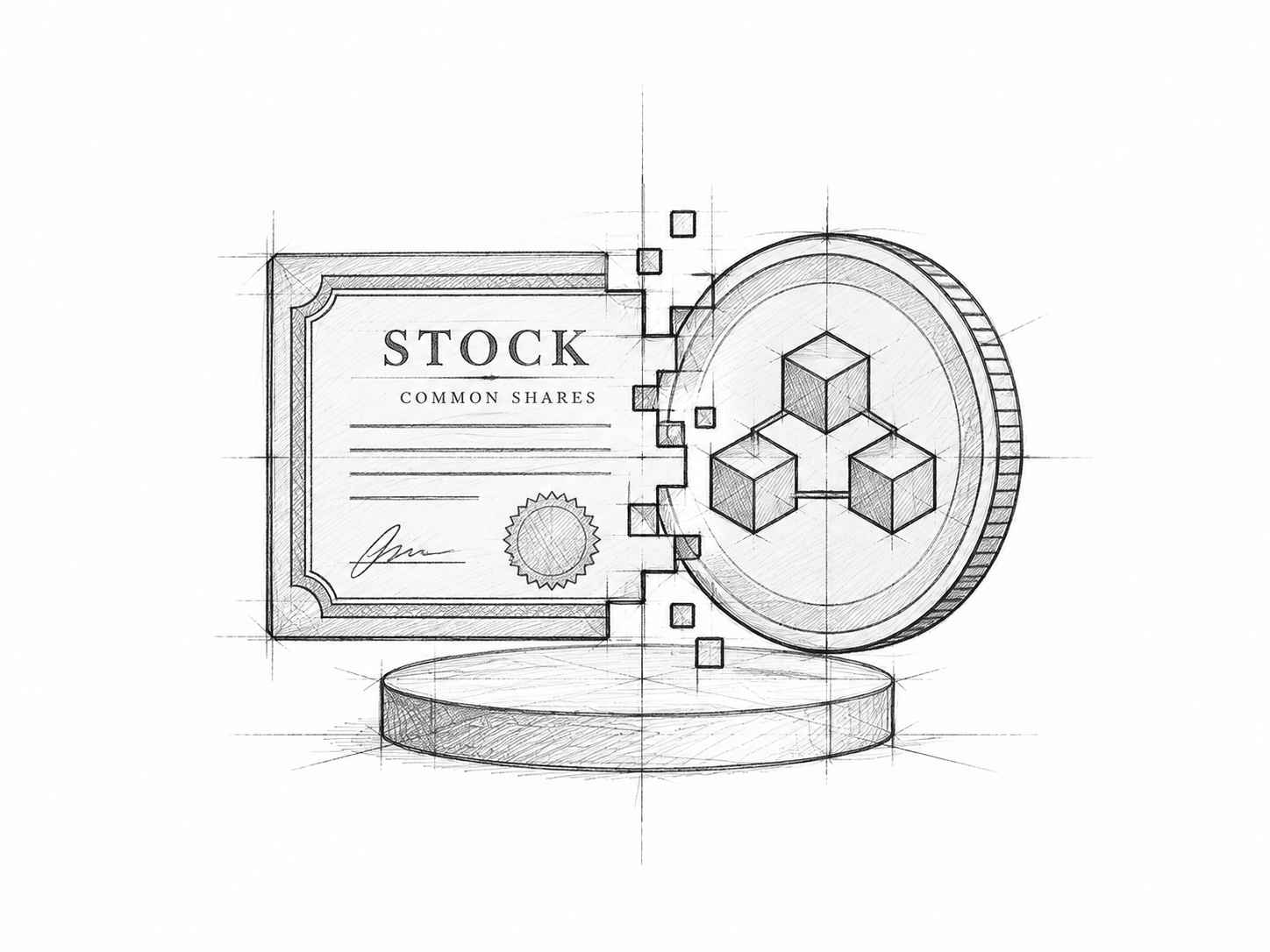
The SEC’s new Innovation Exemption creates a five-year pathway for eligible tokenized US-listed stocks to trade through permissioned AMMs deployed on public blockchain infrastructure. It also gives conditional dealer relief to proprietary liquidity providers supplying capital to those pools.
- The liquidity-provider exemption may prove more consequential than the tokenization headline itself because tokenized equities still need depth, continuous pricing and firms that can hedge between traditional equity markets and onchain venues.
- Bitcoin’s rebound after the Senate failed to advance the CLARITY Act coincided with a broader reassessment of how quickly public blockchain rails could become integrated into US financial infrastructure.
- As tokenized trading becomes easier, liquidity provision may become the more important bottleneck.
- The firms best positioned for this market will need to operate across traditional equity infrastructure and onchain execution at the same time.
On September 15, the US Senate failed to advance the CLARITY Act, delaying comprehensive crypto market-structure legislation. Two days later, the SEC introduced its Innovation Exemption for tokenized securities, with Chairman Paul Atkins explicitly referencing the failure of CLARITY and arguing that the Commission could still use its existing statutory authority to facilitate onchain trading of tokenized US stocks.
Bitcoin recovered from the post-vote selloff soon after. Macro conditions, positioning and broader risk sentiment also influenced the move, so the rebound cannot be attributed to regulation alone, but $BTC’s reversal did coincide with a wider reassessment of how quickly public blockchain infrastructure could become integrated into US financial markets.
The failure of CLARITY had initially suggested that substantial changes to US crypto market structure might remain dependent on congressional action, while the SEC’s response showed that regulators still had room to create narrower pathways under existing authority, including a framework that directly involves US-listed equities trading through blockchain-based infrastructure.
The implications extend beyond whether Apple, Nvidia or another US-listed stock can be represented as a token because the exemption also establishes the market structure within which those assets may trade and identifies the firms allowed to provide liquidity to them.
What the SEC Changed
The Innovation Exemption creates temporary, conditional relief for a new category of venue called a Tokenized Securities Venue, or TSV.
Although TSVs remain subject to meaningful restrictions, including permissioned access, trading-volume limits and eligibility requirements, the SEC also requires the relevant smart contracts to be public, auditable and deployed on a public, permissionless distributed ledger.
The result is a hybrid market structure that combines regulated securities and permissioned participants with AMM-based execution on public blockchain infrastructure.
Why the Liquidity Exemption Matters
Much of the initial attention has focused on which stocks can be tokenized, but the liquidity-provider exemption may have greater implications for how the market develops because a tokenized stock still needs a functioning secondary market with executable prices, inventory management and a reliable link to the underlying security.
The SEC’s relief extends to liquidity providers supplying tokenized NMS stocks to AMM pools using proprietary capital, and those firms may undertake activities associated with professional market making, including quoting prices and committing capital, subject to the exemption’s conditions.
A market maker still needs to keep the tokenized instrument aligned with a security whose reference price is being formed across the existing National Market System, which requires an understanding of both markets and the infrastructure needed to move between them.
One Stock, Two Market Structures
Consider a tokenized Apple share trading through one of these AMMs. The traditional share continues to trade across US equity venues while the tokenized share trades onchain, giving investors exposure to substantially the same underlying asset through two different market structures.
A liquidity provider may need to monitor:
- the underlying equity price
- the tokenized equity price
- the basis between the two
- liquidity and inventory inside the AMM
- stablecoin exposure if the stock is quoted against one
- blockchain settlement conditions
- transaction and rebalancing costs
- available hedging liquidity in traditional markets
A dislocation between the two markets creates a potential trading opportunity only when the market maker can execute onchain and hedge the resulting equity exposure efficiently. If tokenized AAPL trades above its traditional-market equivalent, the firm providing liquidity needs to identify the divergence, price the associated risks, trade through the blockchain venue and manage the corresponding exposure in the underlying market.
This makes the infrastructure gap between traditional and onchain market making important.
Traditional equity firms tend to be strongest in the first column, while crypto-native liquidity providers are more familiar with the second, leaving a comparatively smaller group of firms with the infrastructure and operational experience to work across both.
That group includes firms already accustomed to fragmented liquidity, different execution models, multiple settlement rails and basis risk across centralized and decentralized venues, all of which become relevant when tokenized equities extend those same challenges into US securities.
A Useful Parallel: Regulation ATS
There is a useful historical precedent for this type of regulatory change in Regulation ATS, which the SEC adopted in 1998 as electronic trading systems were beginning to compete more directly with traditional exchanges.
The regulation did not create electronic trading, but it formalized the conditions under which a new trading architecture could operate alongside established exchanges. The Innovation Exemption follows a similar regulatory approach, although today’s framework is narrower, temporary and more limited in scale.
In both cases, the SEC defined the venue, specified who could participate, imposed limits on activity and created a framework through which it could observe how the market developed. The difference today is that part of the trading infrastructure operates on public blockchain rails.
Why the $BTC Reaction Matters
The broader crypto-market reaction helps place the exemption in context because it came immediately after a political setback for comprehensive crypto legislation.
The Senate’s failure to advance CLARITY initially reinforced expectations that meaningful changes to US crypto market structure could remain tied up in Congress, while the SEC’s subsequent action demonstrated that individual components of that market structure could still move forward through agency-level action.
Although the Innovation Exemption is temporary and does not remove the need for broader legislation, it demonstrates that regulated US financial infrastructure can begin experimenting with public blockchain rails before Congress completes a comprehensive framework.
That helps explain why an exemption focused on tokenized equities could matter to the broader crypto market. It provides a concrete example of blockchain infrastructure being incorporated into the design of regulated US financial markets rather than existing entirely alongside them.
As that process develops, the more important questions become which markets move onchain first, which assets attract genuine trading demand, how much liquidity those venues attract, how closely onchain prices track the underlying securities and which firms are capable of connecting the two environments.
What We Would Watch Next
The exemption gives the market room to experiment, but the development of meaningful secondary-market liquidity will depend on how venues, market makers and investors respond.
- Which stocks appear first? Highly liquid names should be easier to hedge, although the SEC’s trading limits constrain how much volume can migrate initially.
- Who operates the first TSVs? Venue design will influence execution quality, spreads and the economics available to liquidity providers.
- Who supplies the liquidity? The composition of early market makers may indicate whether the market develops around traditional securities firms, crypto-native firms or firms with infrastructure across both.
- How tightly do tokenized shares track the underlying? Persistent spreads would reveal where capital, settlement or hedging frictions remain.
- Where does trading volume concentrate? The relevance of tokenized equities will ultimately depend on actual market activity rather than the number of securities that can technically be issued.
Those answers will help determine whether tokenized equities develop into meaningful markets or remain limited experiments, even as the SEC reduces some of the regulatory barriers around bringing US stocks onchain.
As trading becomes easier, the ability to provide enough depth, reliable price formation and cross-market hedging may become the more valuable capability.