We Read (And Ranked) 22 Institutional Crypto Outlooks for 2026 So That You Don't Have To
A synthesis of what Grayscale, Galaxy, Bitwise, Pantera, and others are predicting for 2026, with a look at who actually got 2025 right
Every December, the major crypto institutions publish their predictions for the year ahead. Grayscale releases a 30-page outlook. Pantera writes an investor letter. Messari drops 150 pages of analysis.
Taken together, it represents the closest thing crypto has to a Wall Street consensus.
I read through 22 of these institutional outlooks and pulled out the key predictions, points of agreement, and notable divergences.
But first, I wanted to know: how accurate were these same institutions when they made predictions last year? Who can we trust, and who, less so?
The results were pretty instructive. When it came to price targets, the institutional consensus was significantly way too bullish. Last December, Bitwise predicted Bitcoin would reach $200,000. Galaxy said $185,000. VanEck called for $180,000. Bitcoin peaked at $126,000 in October and ended the year around $87,000.
Every major institution overshot by 40 to 60 percent.
However, the same institutions were remarkably accurate on regulatory and structural predictions. They correctly anticipated the GENIUS Act passing, the Strategic Bitcoin Reserve executive order, Coinbase's addition to the S&P 500, the resolution of major SEC enforcement actions, and the emergence of AI agents as a dominant narrative.
On these calls, the hit rate was close to 80 percent.
One firm stands out. In November 2022, with Bitcoin trading around $16,000, Pantera published a prediction based on their halving-cycle model: Bitcoin would reach $117,482 by August 11, 2025, a date exactly halfway between the April 2024 halving and the expected April 2028 halving. On August 11, 2025, Bitcoin closed above $119,000.
The prediction landed within 1.3 percent of target, on the exact specified date, made nearly 3 years in advance.
The takeaway is not that institutional predictions are useless. It's that they're useful in specific ways. Regulatory and thematic predictions reliable, while price targets have consistently been too aggressive by a significant margin. And methodology matters: Pantera's halving-cycle framework has outperformed the more conventional approaches in this particular case.
With this context established, here's what all these institutions are predicting for 2026.
BITCOIN
The consensus view on Bitcoin is bullish, though the range of predictions is wide and several institutions are notably more cautious than in prior years.
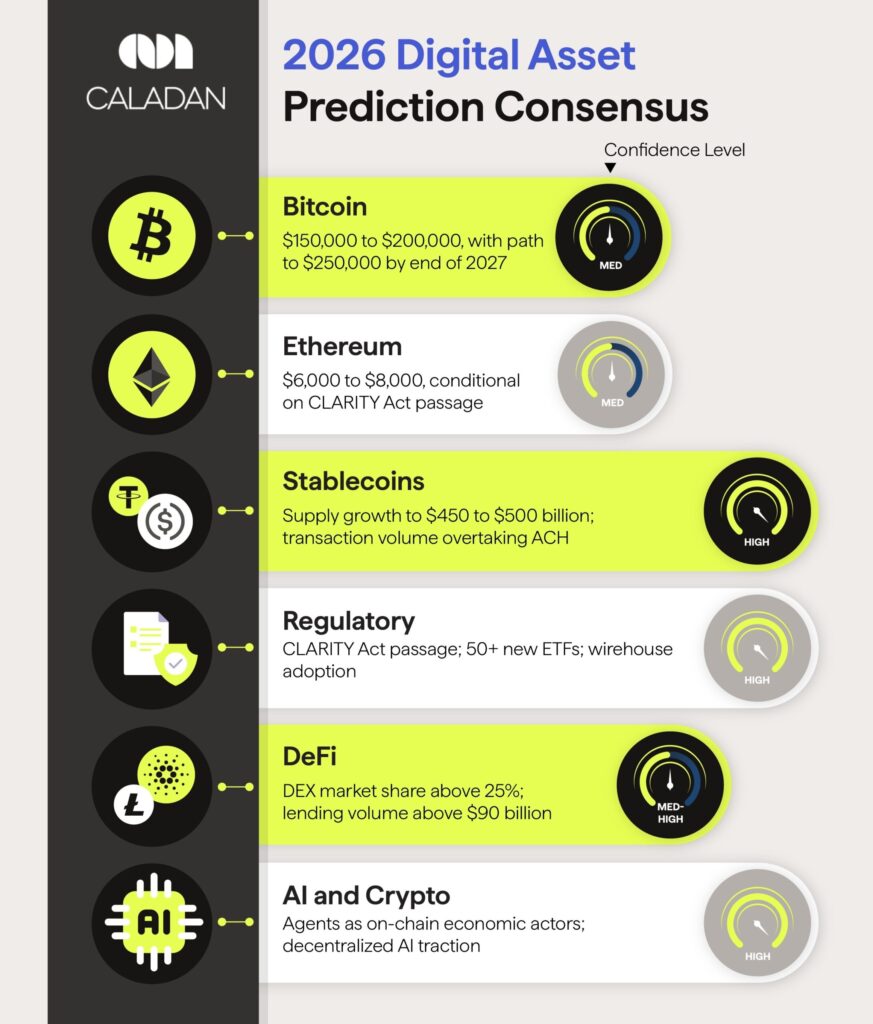
The raw consensus clusters around $150,000 to $200,000 for 2026, with most institutions seeing a path to $250,000 by end of 2027.
However, given the systematic over-optimism observed in 2025 predictions, a more realistic adjusted range might be $130,000 to $180,000.
One pretty important signal that I derived from this: Galaxy Digital, which has historically been among the more specific and bullish forecasters, is explicitly sitting out the 2026 price prediction.
When a traditionally confident voice declines to offer a target, it suggests elevated uncertainty even among the bulls.
ETHEREUM
Ethereum predictions are generally constructive, but nearly all come with an important caveat: they are contingent on regulatory progress.
The consensus range is $6,000 to $8,000, with Bitcoin Suisse at the upper end.
The critical variable is regulatory: almost every prediction is explicitly tied to whether the CLARITY Act passes. If market structure legislation stalls in the Senate, these targets would likely need to be revised downward significantly.
This regulatory dependency makes Ethereum predictions inherently less certain than Bitcoin predictions, where the investment case is less contingent on specific legislative outcomes.
SOLANA AND OTHER LAYER 1s
Solana receives less detailed coverage in the institutional outlooks, but the general sentiment is positive.
Several institutions expect SOL to benefit from the same institutional flows entering BTC and ETH, and Galaxy predicts that 50 or more altcoin ETFs will launch in the US during 2026, with Solana likely among the early candidates.
The bull case rests on continued DeFi activity growth, stablecoin adoption on the network, and the potential for ETF-driven institutional access. Sui, Aptos, and other newer Layer 1s are mentioned as potential breakout candidates, but with considerably less conviction.
A note of caution is warranted here.
Altcoin predictions were the least accurate category in 2025. Galaxy had projected Solana reaching $500 to $750; it peaked around $300.
Hence, specific altcoin price targets should be treated with significant skepticism given this track record. The market regime/structure around altcoins has also changed pretty drastically from a year ago, so this is important to take note of too.
STABLECOINS
Stablecoins represent the highest-conviction theme across the institutional outlooks, and for good reason: this is the category where 2025 predictions were MOST accurate.
Institutions correctly anticipated the GENIUS Act passage and the general direction of stablecoin growth.
The key predictions for 2026:
The confidence level here is high, and for good reason. Stablecoins are increasingly viewed not as a speculative crypto subsector but as genuine financial infrastructure with clear use cases in payments, settlement, and treasury management.
The regulatory framework is now in place, and the integration with traditional finance is accelerating.
REGULATORY AND POLICY
Regulatory predictions were the most accurate category in 2025, with institutions correctly calling the GENIUS Act, the Bitcoin Reserve executive order, SEC leadership changes, and the general shift toward a more constructive policy environment.
This track record lends credibility to the 2026 regulatory outlook.
Key predictions for 2026:
The confidence level here is high. The regulatory environment has shifted meaningfully, and the predictions are largely extensions of trends already in motion rather than speculative leaps.
DEFI AND THE ONCHAIN ECONOMY
The DeFi predictions center on a structural thesis: value capture is shifting from infrastructure to applications.
The overarching theme is that the "Fat Protocol" thesis, which held that value would accrue primarily to base layer infrastructure, is giving way to a "Fat Apps" model.
Hyperliquid's success in 2025 demonstrated that applications can capture more value than the chains they run on.
This suggests a maturation of the space toward more traditional competitive dynamics based on revenue, margins, and user value rather than purely on TVL and token incentives.
AI AND CRYPTO CONVERGENCE
a16z correctly identified AI agents as an emerging theme in their 2025 predictions, and the AI-crypto intersection features prominently in the 2026 outlooks.
Key predictions:
- AI agents become meaningful on-chain economic actors, executing transactions and managing assets autonomously (a16z, Grayscale, Galaxy)
- The x402 agentic payment standard reaches 30% of Base transactions and 5% of Solana transactions (Galaxy)
- Decentralized AI platforms such as Bittensor gain significant traction as alternatives to centralized AI infrastructure (Grayscale)
- Concerns about AI centralization drive interest in blockchain-based solutions for model training, inference, and data provenance (Grayscale)
- Proof-of-personhood systems see meaningful adoption as AI-generated content proliferates (Galaxy)
The thesis here is that blockchain infrastructure solves specific problems created by AI advancement: the need for machine-to-machine payments, verifiable computation, and human verification in an increasingly automated world.
THEMES OF CONSENSUS
Despite differences in methodology and specific predictions, the institutional outlooks converge on several broad themes:
The institutional activation phase has arrived
The consensus view is that 2025 was about building infrastructure and achieving regulatory clarity, while 2026 is when institutional capital actually begins to deploy at scale. Wirehouses are opening access to crypto products.
Model portfolios are being updated to include digital asset allocations. Pension funds and endowments are moving through their approval processes.
This capital moves slowly through compliance and governance structures, but the direction is clear.
The four-year halving cycle may be breaking down
Grayscale and Bitwise explicitly argue that the traditional boom-bust pattern driven by Bitcoin halvings will be dampened by steadier institutional flows. Pantera's cycle model, which has been the most accurate, still anticipates appreciation through 2027 and 2028, but with lower volatility than prior cycles.
The implication is that crypto markets may begin to behave more like traditional asset classes as the investor base matures.
Regulatory clarity is the primary catalyst
With the GENIUS Act signed, CLARITY Act expected, new SEC leadership in place, SAB 121 rescinded, and banks permitted to custody crypto, the US regulatory environment is the most favorable it has ever been.
This is unanimously viewed as bullish, with the only debate being about magnitude and timing of impact.
Stablecoins are transitioning from crypto infrastructure to financial infrastructure
The use case has expanded beyond trading collateral to include cross-border payments, card network settlement, and enterprise treasury management.
This represents one of the clearest examples of crypto technology achieving product-market fit outside of speculation.
Value is migrating from protocols to applications
The success of Hyperliquid and similar application-layer protocols has challenged the assumption that base layers will capture most of the value in crypto ecosystems.
The expectation is that this trend accelerates, with more protocols competing on fundamentals like revenue and user value rather than TVL.
AREAS OF LOW CONCERN
Two themes that generated significant attention in 2025 are notably ABSENT from institutional concern lists for 2026:
Quantum computing
This is explicitly characterized as a "red herring" by both Grayscale and Bitcoin Suisse. Research into quantum-resistant cryptography will continue, but no institution sees near-term implications for crypto valuations or security.
Digital Asset Treasuries
The MicroStrategy-inspired corporate Bitcoin strategies that proliferated in mid-2025, are not expected to be a significant factor in 2026.
Grayscale does not see them as a major swing variable, and Galaxy predicts that five or more DAT companies will be forced to liquidate holdings, be acquired, or shut down as the initial enthusiasm fades.
SUMMARY
The highest-conviction predictions for 2026 are not about specific price targets.
They center on the continued acceleration of regulatory clarity and stablecoin adoption. These are the areas where institutional forecasts have historically been most reliable, and where the current consensus is strongest.
Price targets, while useful as directional indicators, should be adjusted for the aforementioned systematic over-optimism observed in prior years.
A reasonable approach is to apply a 25 to 35 percent discount to consensus price predictions (if you want to trust them at all) while taking regulatory and structural predictions largely at face value.
Appendix (Prediction Track Record Analysis)
This analysis evaluates the accuracy of major institutional crypto forecasters' 2025 predictions (published late 2024) against actual 2025 outcomes.
The goal is to establish credibility weightings for their 2026 predictions, enabling more informed interpretation of current forecasts.
Key Findings:
- Pantera Capital achieved exceptional accuracy with their halving-cycle based BTC price prediction, hitting within 1.3% of their target on the exact date specified
- Price targets were systematically over-optimistic across all institutions, with BTC predictions averaging 52% above actual peak ($126K vs. targets of $150K-$200K)
- Regulatory and structural predictions outperformed price targets significantly, with stablecoin legislation (GENIUS Act), Bitcoin strategic reserve, and Coinbase S&P 500 inclusion all correctly predicted
- Thematic calls around AI agents, stablecoin adoption, and DeFi growth proved broadly accurate
Methodology
Scoring Framework
Each prediction was scored on a 0-10 scale based on:
- Specificity: Precise, falsifiable predictions scored higher than vague directional calls
- Accuracy: Binary outcomes (correct/incorrect) for regulatory/corporate predictions; percentage-based for price targets
- Timing: Predictions with specific timeframes received credit for timing accuracy
Prediction Categories
- Price Targets: Specific numerical predictions for BTC, ETH, SOL, etc.
- Regulatory: Policy, legislation, enforcement predictions
- Thematic: Narrative and trend predictions (AI agents, stablecoins, DeFi)
- Corporate/Structural: Index inclusions, IPOs, institutional adoption
- Flows: ETF inflows, capital allocation predictions
Weighting Formula
Base Credibility Weight = (Overall Score / 10) × Specificity Multiplier × Track Record Consistency
Weights range from 0.7 (low credibility) to 1.3 (high credibility), applied to 2026 predictions.
Actual 2025 Outcomes (Verification Data)
Institution Scorecards
Pantera Capital
Overall Score: 8.5/10 | Credibility Weight: 1.3x
Assessment: Exceptional price accuracy from Nov 2022 prediction. Halving cycle model validated.
VanEck
Overall Score: 6.5/10 | Credibility Weight: 1.1x
Assessment: Price targets too aggressive. Structural and regulatory calls strong. Self-scored 8.5/15 for 2024.
Bitwise
Overall Score: 5/10 | Credibility Weight: 0.9x
Assessment: Most aggressive price targets significantly overshot. Corporate/index predictions strong.
Galaxy Digital
Overall Score: 5.5/10 | Credibility Weight: 1x
Assessment: Publicly stated 2026 is 'too chaotic to predict.' Regulatory calls accurate, price targets overly bullish.
Grayscale
Overall Score: 6/10 | Credibility Weight: 1x
Assessment: Focused on themes over price targets. Token picks methodology transparent. Conservative approach.
a16z Crypto
Overall Score: 6.5/10 | Credibility Weight: 1x
Assessment: Thematic focus without price targets. Strong on AI/stablecoin calls. VC perspective evident.
Summary: Credibility Rankings for 2026 Predictions
Key Lessons from 2025 Prediction Analysis
- Structural predictions outperform price predictions consistently
- Institutions with transparent methodologies (Pantera's halving model) enable better evaluation
- Regulatory predictions benefit from direct policy engagement and tend to be more accurate
- Thematic calls require patience - most unfold over 12-18 months, not quarterly
- Self-scoring institutions (Galaxy, VanEck) provide accountability baseline
- Consensus price targets should be discounted 25-35% based on historical over-optimism